

I work with brands on Instagram to promote their content to my followers. When the content is either paid or the type of content is controlled by the brand, this is classed as an AD. Users who post ADs (and I don’t mean paid ad campaigns that are run through Instagram to reach more users), tend to see lower engagement on some of their promotional posts. But why is this?
I’ve asked this question so many times to myself, humans and Google and I have had no response. It’s for this reason that I’ve decided to put together my own answer, based on my experience and knowledge of the current Instagram algorithm and user’s habits. This blog is not to say ADs do not perform well, merely that they don’t all tend to receive the same amount of reach as organic posts.
To give a quick recap of how the Instagram algorithm works in 2019:
- Posts that do well are usually from users who regularly interact with multiple accounts, therefore ensuring the algorithm displays their new content to these users. The more of one user’s posts someone likes, the more likely they are to see their new content.
- Instagram prioritises posts of interest on the news feed that match the user’s interests. For example, if you always like and engage with users posting travel photos, it will try to show you more of these types of content.
- The app also favours accounts that post regularly, they are more likely to display a post on the timeline from someone who posts daily than monthly for example.
- The users you engage with the most are more likely to show up at the top of your feed.
So with all this in mind, if you’re creating content that suits your audience, offer them relevant hashtags that suit their interests and the content is something they normally engage with and you post regularly, you should be dreaming right? Wrong. Because the minute you put AD into your caption, the post doesn’t seem to reach as many users.
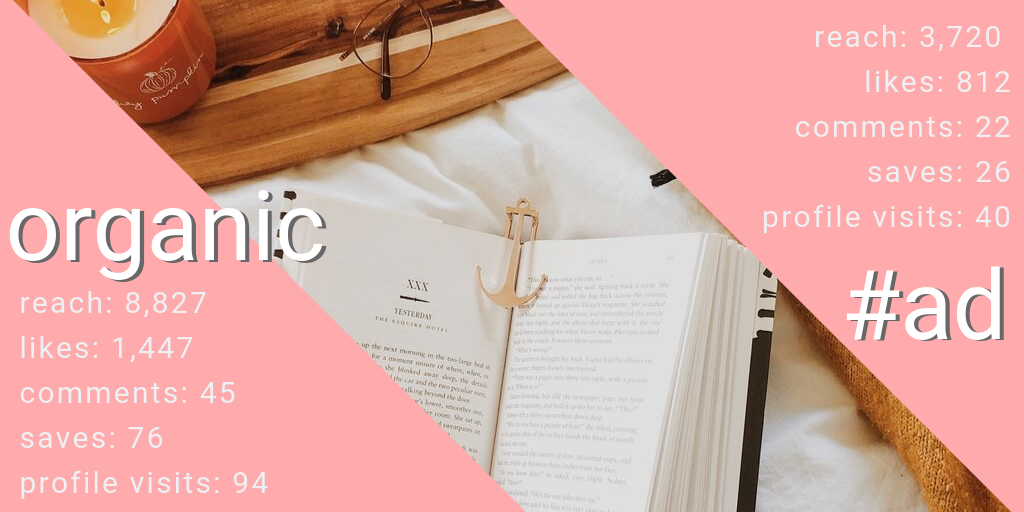
According to the CMA guidelines, it is specified that users sharing an AD must specify clearly that their content is an AD. To avoid confusion, it is best practice to display this in the first line of your caption copy. This is the first difference we can see when comparing an AD post to a normal post to Instagram.
When you create your usual posts you are in complete control of your content, you can make it suit your audience perfectly. But when dealing with brands, it is sometimes more challenging to make their product fit. Of course we all want to work with relevant brands that are true to our audience, but this content will still be new and different for our viewers and for Instagram’s algorithm. In my case, this may be a book that isn’t yet in the public eye, perhaps an independently published book that is lesser known. This means there are less people looking at the hashtags for this book, less people who know the cover and sadly this does mean less people will stop and look at the book. Of course this is the point of these collaborations, for brands to reach audiences they haven’t previously been able to. I try my very best to promote the brands that I work with to the best of my ability and in a way I think will really engage my audience, but sometimes it is in the algorithms hands.
But are people reading the AD captions and engaging with the posts?
When you scroll through your feed, do you find you stop and read the AD posts, or do you keep scrolling past them? Do you feel like the user posting them is offering you genuine content or are you put off by the label of AD? It’s arguable that people scrolling through their news feed are less likely to stop at an AD because they don’t think it is offering them genuine and real content. Of course for the users posting this AD it’s bad news, because they want to be able to bring in high engagement to help the brand they are working with. However there are also the users that will see this is an AD and know this is important to the user and brand, so they stay to leave a genuine comment – these users are superb humans and we LOVE you!
Of course it depends what is in the photo to an extent, but sometimes the photo can be of a popular book and just not do well purely because of the AD tag. I recently promoted a collection of books that are currently very popular, they are aesthetically pleasing and people are talking about them online. The photo was well composed and the caption was interesting and engaging, so why did the post not receive the same amount of likes as my other photos? I’m not saying these posts don’t get strong engagement, because they do, but in comparison to other posts, it does always seem to be less.
Asking fellow users how they engage with ADs
In a Twitter poll I discovered that to most users, having the AD tag doesn’t affect their engagement on a post. This suggests that users are no less likely to interact with your post if it is or isn’t an AD, which would imply the reach and engagement of these posts is down to Instagram itself. But users have said they are less likely to engage with the post if it is something unrelated to the normal content the account posts. For example, if a Bookstagram account suddenly starts posting ADs for a kitchen utensil, this would seem a bit odd and unrelated and therefore wouldn’t be targeting the correct audience.
Whether the algorithm filters the word AD and doesn’t push these posts to as many users, I don’t know. It seems unlikely that they would do this as their platform is a marketing tool. Of course it’s possible that when brands work with influencers to run outreach campaigns, they are risking over-saturating the market by spreading their product across Instagram over a condensed period of time. If all you’ve seen on your feed is the same book all day, you’re likely to get bored of this content and will be less inclined to engage with it.
So what is it that stops some of our ADs reaching quite as far?
I think overall looking at my previous AD posts and comparing them to my organic content, the only difference I see is the books used. Therefore I would have to draw the conclusion that it isn’t Instagram’s algorithm prohibiting our ADs from reaching more people, but the photos themselves. If I compare my ADs, the ones that feature a highlight popular book for example, still reach the same amount of people as my day to day posts. Whereas the posts with lesser known books are reaching a smaller audience. It’s a shame that it works this way, but I’m still glad I’m able to promote these books to my audience and hopefully invite new readers to enjoy them.
I didn’t start this blog post with a set outcome, but I enjoyed researching into it and talking to you about your experiences. It seems that whilst we have a lot of things to blame Instagram’s algorithm for, AD performance may not be one of them.






Fantastic post! There is so much with the Instagram algorithm that it’s hard to wrap my head around it.